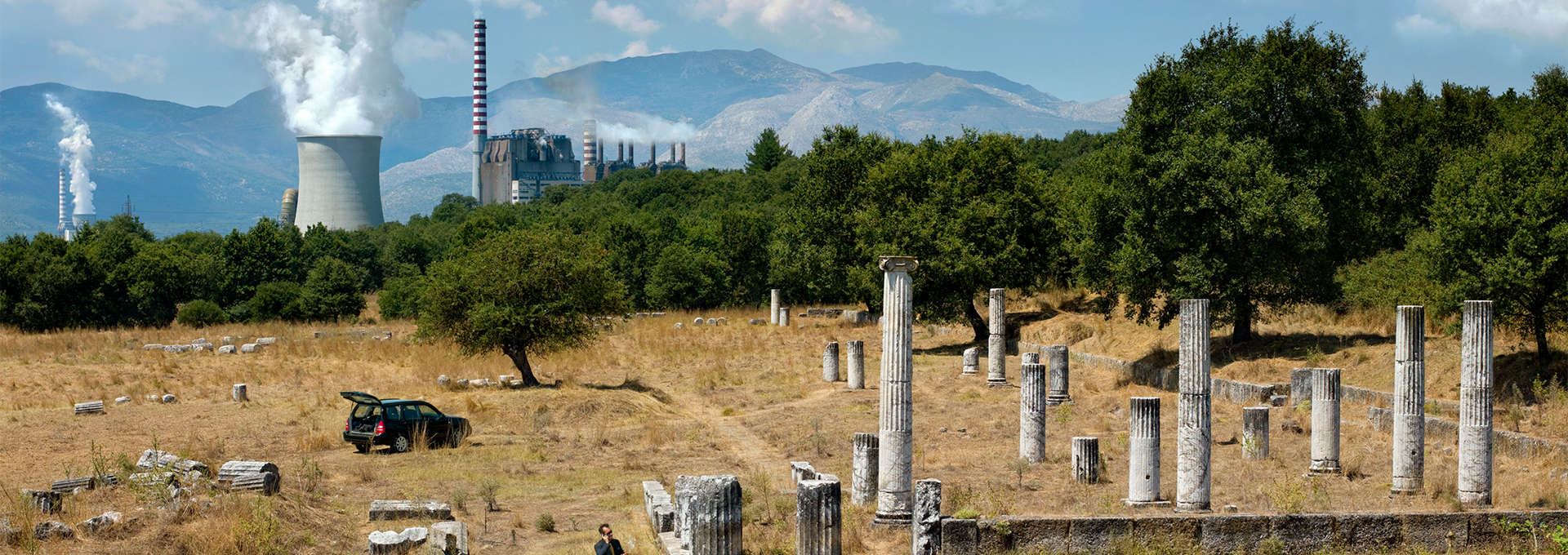
South by Southeast marks a pivotal moment in the evolution of EMΣT’s collection and its orientation. Drawing on recent acquisitions, donations, as well as existing works in the collection and donations, the exhibition foregrounds a new collection policy, begun in 2021, that looks beyond inherited Western canons and repositions Greece within a wider Mediterranean and south-eastern European cultural geography—one that extends through the Balkans, Turkey, the Middle East, and North Africa. In doing so, it reframes Greece not as the periphery of Western Europe, but as a central node in South East Europe and the Middle or ‘Near’ East, a historically entangled region shaped by mobility, exchange, conflict, multilingualism, and layered identities. The exhibition includes 50 artists from more than 20 countries.
The exhibition’s title is a deliberate play on Alfred Hitchcock’s film North by Northwest, signaling a symbolic reorientation away from the long-standing fixation on Anglo-Saxon and Western European cultural paradigms that has marked Greek modernity since independence. Instead, South by Southeast insists on a more complex, plural cartography—one that acknowledges Greece’s strategic geographical location at the crossroads of continents, empires, and belief systems, and its deep historical affinities with the region once known as the Levant. This shift resonates with broader cultural and geopolitical currents, including what has been described recently as a contemporary “turn East” in Greece, reflecting renewed political, economic, and cultural engagements with neighbouring regions.
In a recent book, The New Byzantines: The Rise of Greece and Return of the Near East (2025), writer Sean Mathews argues that Greece is undergoing a geopolitical and cultural reorientation toward the Eastern Mediterranean and the Near East, rather than being exclusively part of the Western world. Mathews is not alone in suggesting that the idea of modern Greece as a purely Western construct is largely a 19th–20th century phenomenon, imposed on the small newly formed country by the great European powers of the time. After independence from the Ottoman Empire following the Greek War of Independence, the political structure of the new Greek state was largely determined by three European Great Powers: the United Kingdom, France, and Russia. Seeking stability and a balance of influence in the region, these powers decided that Greece should become a monarchy and selected the young, inexperienced Bavarian prince Otto of Greece as its first king (who was incidentally also a Roman Catholic). This arrangement was formalised in the Treaty of London (1832), which recognised Greece as an independent kingdom under their protection.
The process of nation-building that followed looked back to classical Greece and antiquity, emphasizing a Western, Hellenic heritage while largely disavowing the Byzantine and Ottoman-influenced past, in order to create a modern European-oriented state aligned with contemporary Western enlightenment deals of civilization and progress. Greece consciously aligned itself with Western Europe, a stance reinforced during the early Cold War: under the secret Percentages Agreement between Winston Churchill and Joseph Stalin in 1944, Greece was placed firmly in the Western sphere, outside the Soviet-controlled Eastern Bloc and the emerging Iron Curtain. Later, Greece maintained this alignment through institutions such as NATO and the EU.
Greece’s deep historical ties to the Eastern Mediterranean— somewhat suppressed during its Western integration—are now reasserting themselves through economic flows, regional diplomacy, geopolitical developments and conflicts in the Middle east, and cultural continuities. While Greece remains structurally Western, with its economy, legal frameworks, security structures, and EU membership firmly oriented toward Europe, its cultural affinities with the East are equally significant. Centuries of Ottoman rule, long-standing rivalry with Turkey, and its position outside the Iron Curtain contributed to a partial disavowal of these Eastern connections. The EMΣT collection policy seeks to reverse this trend, uncovering hidden stories, entanglements, and shared histories with neighbours to the north, south, and east.
Every museum collection is, by its nature, incomplete—marked by gaps, absences, and questions that cannot all be answered. In today’s vast and interconnected art world, it is impossible to collect everything. Depth, focus, and coherence become essential: a collection must concentrate in order to illuminate, to make connections meaningful, and to tell stories that resonate within the space it is situated in as well as beyond. Our focus on the Mediterranean, North Africa, the Middle and Near East, and the Balkans reflects Greece’s unique position at the crossroads of these regions, shaped by historical ties, cultural affinities, diasporic identities and shared experiences. The best collections are not those that encompass everything, but those that hold together, that speak with clarity and purpose. This is our story of South by Southeast —a narrative of connection, exchange, and the rich, entangled histories of our region.
This wider region addressed by South by Southeast is rich in narratives rooted in the multi-cultural, socio-political, and historical dynamics of the Mediterranean world, the Balkans, and south-eastern Europe. It is a region shaped by imperial legacies, shifting borders, postcolonial struggles, war, and forced migration, as well as by enduring traditions of hospitality, trade, artistic circulation, and intellectual/artistic exchange. The artworks presented here engage with these dynamics, tracing how history reverberates in the present and how personal memory intersects with collective trauma and political reality.
The significance of this exhibition in Greece today cannot be overstated. In the wake of the financial crisis, intensified migration flows, and the reconfiguration of Europe’s political landscape, questions of identity, belonging, and cultural orientation have taken on renewed urgency. Greece’s position as a frontline state in the so-called “refugee crisis” and as a bridge between Europe and its southern and eastern neighbors has exposed deep fault lines in European solidarity, while also highlighting the country’s long-standing entanglement with the region’s histories of movement and displacement. Today, with the Middle East in flames once again, Greece serves as a safe haven and, by comparison, a model of stability. South by Southeast responds to these conditions by offering a counter-narrative to insular nationalism and Western exceptionalism, foregrounding shared histories, intersecting futures, and a common cultural space shaped by circulation rather than closure and polarisation.
By bringing these perspectives into dialogue within the framework of a national museum, South by Southeast articulates a curatorial and institutional commitment to rethinking Greece’s cultural self-understanding. It proposes a move away from an inherited Western gaze toward a more situated, relational perspective that acknowledges Greece’s embeddedness in a complex regional ecology. In doing so, EMΣT affirms the Mediterranean, south-eastern Europe, and the wider Near East not as marginal zones to European modernity, but as generative sites of artistic production, critical thought, and cultural innovation.
Ultimately, South by Southeast is not only a presentation of recent acquisitions; it is a proposition about how we might imagine the future of cultural institutions in a multipolar world. It invites viewers to reconsider where Greece stands—historically, geopolitically, and culturally—and to recognise the creative and critical potential that lies in embracing the country’s south-eastern orientation as a source of inspiration and renewed cosmopolitanism. The latter issue will be explored in a major group exhibition opening at the museum on December 10th this year.
Opening: Thursday 11 June | 20:00-23:00
EXHIBITION GUIDECurated by Katerina Gregos
ARTISTS
Lawrence Abu Hamdan, Diana Al-Hadid, Monira Al Qadiri, Athanasios Argianas, Lynda Benglis, Pier Paolo Calzolari, Chryssa, Bia Davou, Navine G. Dossos, Eirene Efstathiou, Stelios Faitakis, Apostolos Georgiou, Ivan Grubanov, Artan Hajrullahu, Mona Hatoum, Giorgos Ioannou, Emily Jacir, Sven Johne, Konstantin Kakanias, Dionisis Kavallieratos, Bouchra Khalili, Panos Kokkinias, Jannis Kounellis, Ange Leccia, Nate Lowman, Rabih Mroué, Eleni Mylonas, Jennifer Nelson, Gabriel Orozco, George Osodi, Adrian Paci, Leda Papaconstantinou, Maria Papadimitriou, Malvina Panagiotidi, Rena Papaspyrou, Antonis Pittas, Walid Raad-The Atlas Group, Thomias Radin – Alexander Brack – Matthias Meisen, Michael Rakowitz, Serban Savu, Nedko Solakov, Sphinxes, Thomas Struth, Lina Theodorou, Costas Tsoclis, Vangjush Vellahu, Kostis Velonis, Vangelis Vlahos, Eirini Vourloumis, Akram Zaatari
EXHIBITION CREDITS
Curator: Katerina Gregos
Administrative – Financial Direction: Athina Ioannou
Architectural Design – Production: Yannis Arvanitis
Graphic Design: Schema – Dimitra Chrona
Assistant Curator: Eleni Koukou (Advisor Collections)
Associate Curator: ioLi Tzanetaki (Advisor Exhibitions)
Registrar-Loans: Maria Drakou
Conservator: Fotini Alexopoulou (EMΣT), Amalia Siatou
EMΣΤ Learning Department: Marina Tsekou, Elisabeth Ioannides, Dimitris Kannas, Ioakeim Theodoridis
Communication (EMΣΤ): Marigo Siakka
Μedia Relations: Maria Tsolaki
Social Media: Sergio Zalmas
International Press and PR: Pickles PR (Amanda Kelly, Vanessa Saraceno)
Administrative-Financial Direction Office: Sophia Papageorgiou
Photography: Paris Tavitian
Chapter Texts: Katerina Gregos
Texts: Katerina Gregos, Eleni Koukou, Anna Mykoniati, Tina Pandi, Stamatis Schizakis, Maria Skamaga, Ioakeim Theodoridis, ioLi Tzanetaki
Text Editor: Maria Skamaga
Translations: Vassilis Douvitsas
AV Coordination: Stamatis Schizakis Audiovisual Installation: M-Spirit
Constructions and Space Planning: Miltos Altintzis & C.M.Construction & Management
Transportation and Art Handling: consTRUCKtivist Fine Art Packing & Transport, Artlock Handling Art
Exhibition & Loans Support: Emmanouela Fourtouni Insurance: Karavias Underwriting Agency Lighting: Sakis Birbilis
Lighting Technical Support: Grigoris Kourelis
Deputy Director of Technical Services: Iro Nikolakea Technical Support: Gregory Sampanis, Vangelis Filippas, Emilios Petrikis, Vaggelis Kiousis
Frames: Sdralis Artworks
Graphic Design (ΕΜΣΤ): Iliana Siarga, Konstantinos Lagos
Prints: Nikos Paschalidis – Paschalidis Digital Printing
Special thanks to:
Katerina Chatzi, Mona Hatoum & Gerry Collins, Dimitra Ioannou, Dimitris Ioannou, Cleopatra Kalligeri, Christina Makri, Natasha Polymeropoulos, Eugenia Stamatopoulou, Georgia Theodoraki, Ioanna Vryzaki, Katerina Zachou, The D.Daskalopoulos Collection, The Dakis Joannou Collection, The Irene Y. Panagopoulos Collection
PRESS MATERIAL

SPONSORS