As part of the EMΣT temporary exhibition Why Look at Animals? – A Case for the Rights of Non-Human Lives, at ΕΜΣΤ, the Museum’s Education Department collaborated with the Athens Residential Women and Mothers Addiction Treatment Unit of the National Organization for Prevention and Addiction Treatment to organise an artistic stop-motion animation workshop.
During the programme, a selection of contemporary artworks was presented and discussed, aiming to activate observation, empathy, and critical thinking around the relationship between human and non-human life. The aesthetic experience served as a starting point for participants to recall memories from childhood or from their recent past, which they then shared with the group. Through a collective process, these individual narratives were transformed into a shared story that became the basis for the creation of the animation.
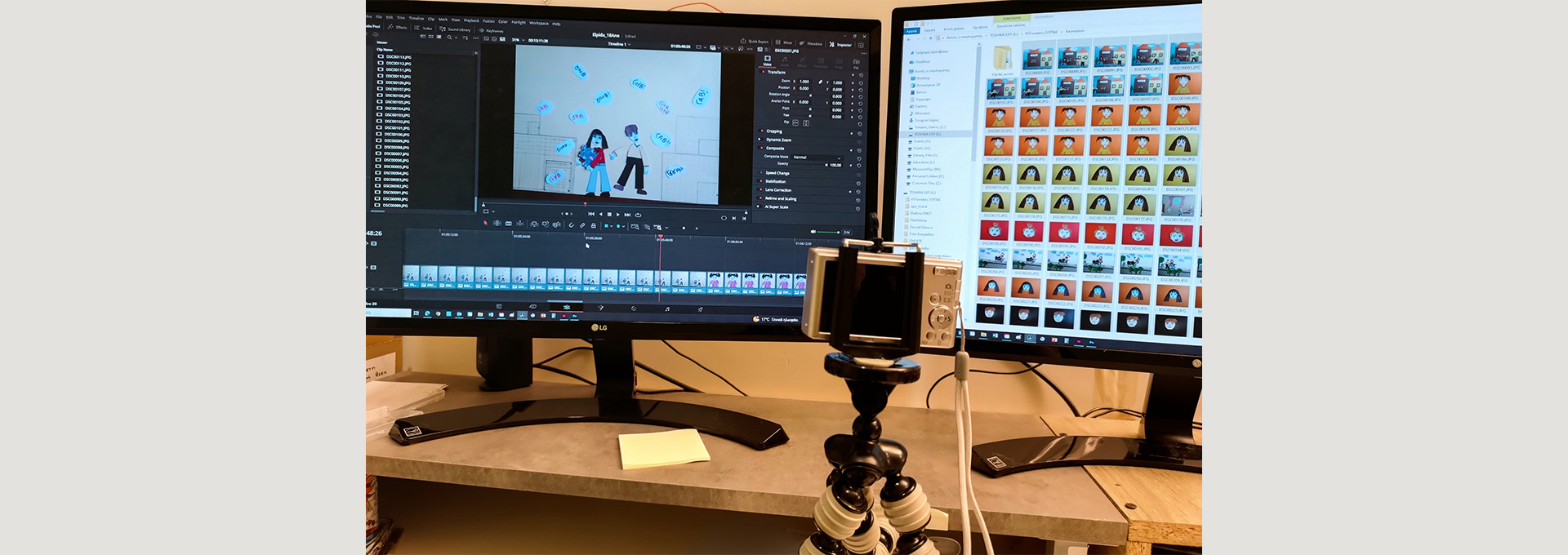
Using a variety of materials, such as white and coloured paper, cardboard, markers, and glue, the characters and sets of the story were constructed. This was followed by a series of photographic shots, recordings of dialogue and ambient sounds, in order to gather the necessary material, which was then uploaded to an application for the completion of the short animation film.
The final work brings forward values connected to love, care, and empathy towards animals, while also addressing deeper issues related to women’s experiences: the mother–daughter relationship, family bonds, resilience, and the strength of female identity. The animation process functioned as a space in which the women were able to express themselves, be heard, and collaboratively shape a narrative that concerns and empowers them.
Curated by: Dimitris Kannas, visual artist, Marina Tsekou, education curator, in collaboration with Ioannis Vastardis, therapist
Programme Objectives:
- To enable art to function as a tool for personal expression, therapeutic exploration, and social connection.
- To highlight the power of collective storytelling as a means of empowerment and visibility.
- To enhance access to cultural activities for vulnerable social groups.
- To create a final artistic work that reflects the experiences, voices, and creativity of the participants.
- To disseminate the material through digital platforms, strengthening the visibility of vulnerable groups while raising awareness around issues of social inclusion and contributing to the elimination of stereotypes.