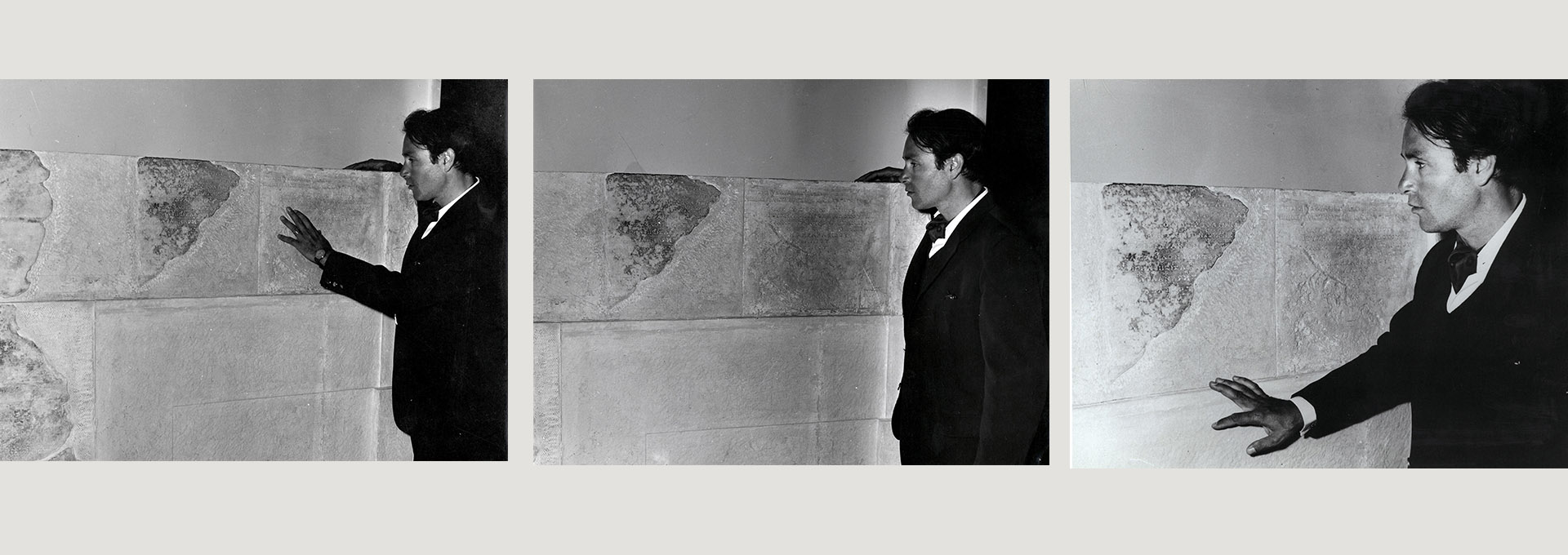
Jani Christou (1926-1970) is a major figure of the twentieth-century musical avant-garde, yet he remains largely under-explored even within the field of music. Quite apart from his musical achievements, this seminal Greek composer was first and foremost someone whose practice was preoccupied with the intersection of art and human experience. “I engage in philosophical thought and the outcome is music”, he would observe, which is why we might describe him today not only as a philosopher of sound but also as a sonic philosopher. His work is distinguished by a singular sense of cohesion and consistency, a radical approach to musical and artistic convention and, above all, a spiritual undercurrent that runs through his compositions: the power of myth and of the transcendental, the life-giving force of ritual, primordial fears and the visceral grip of panic and delirium.
Since his untimely death in a car accident – at the age of only 44 and at the very peak of his creative powers – references to Christou’s life and work have often taken the form of a quasi-mythological narrative emphasising anecdotal history and mystical interpretations.
The exhibition at ΕΜΣΤ represents the first major institutional effort to introduce Jani Christou to a wider audience through the rich documentation within the archive he left behind, where he outlined his thoughts and multifaceted practice. For the first time, the contents of the Jani Christou Archive, housed at the Centre for Research and Documentation of the Athens Conservatoire, are made available to the public, opening up a window to the world of the artist’s inspiration, his thought and method, and the intersection of his work with other disciplines, whether artistic, philosophical, scientific or mundane – in other words, with what he termed the human experience.
Borrowing its title from Christou’s eponymous work, the exhibition takes on a dual form: it unfolds with the logic of a musical score, while simultaneously serving as a bidirectional chronicle that traces the composer’s career across both time and space. Archival materials such as letters, photos, music scores, books, philosophical texts and handwritten notes, are complemented by a bespoke acoustic environment that encapsulates Christou’s sonic universe, ranging from audiovisual fragments to recordings of major orchestral works.
The exhibition reflects ΕΜΣΤ’s sustained engagement with avant-garde and experimental music, as evidenced by the two exhibitions exploring the work of Iannis Xenakis – Iannis Xenakis: Sonic Odysseys and Xenakis and Greece – organised in 2023-2024, and by its ongoing collaboration with the Athens Conservatoire, not to mention its robust programme of musical events.
The exhibition is produced by EMΣΤ with the collaboration of the Athens Conservatoire. It is curated by musician and musicologist Costis Zouliatis, who also oversees the Jani Christou Archive.
The exhibition design is by architect Thalia Melissa.
Opening: Thursday 2 April at 19:00
Curated by Costis Zouliatis
BIOGRAPHY
Jani Christou was born to Greek parents in Heliopolis, Cairo, on January 8, 1926. Raised in cosmopolitan Alexandria, he attended Victoria College and began composing at an early age while studying piano under Gina Bachauer. In the mid-1940s, he traveled to England to study Moral Sciences (Philosophy) at King’s College, Cambridge, at a time when Ludwig Wittgenstein and Bertrand Russell were part of the faculty. Simultaneously, he took private lessons in harmony and counterpoint with Hans Ferdinand Redlich —a distinguished musicologist and Alban Berg scholar— before moving to Italy in 1949 to attend summer composition courses at the Accademia Chigiana in Siena, as well as orchestration studies with Angelo Francesco Lavagnino, who was mostly known for his film scores.
At the dawn of the 1950s, Christou debuted his first major orchestral compositions: Phoenix Music (1949–50) and Symphony No. 1 (1951), works that saw an impressive premiere in London conducted by Alec Sherman. These were followed by the Latin Liturgy (1953) and Six T. S. Eliot Songs (for piano or orchestra and mezzo-soprano) – 1955 (piano) / 1957 (orchestra.) He traveled extensively across Europe, spending time in Zurich where he came into contact with the circle of C. G. Jung through his elder brother, Evanghelos (Evis) Christou, a graduate of the Jung Institute. In 1956, he married his childhood friend Theresia (Sia) Choremi, a painter from Chios who would support him in all his creative endeavors. That same summer, Evis Christou was killed in a car accident in Egypt—a tragedy that had a profound impact on the composer’s psychological and creative life, as he credited his brother with his initiation into the worlds of philosophy, psychology, and spiritual inquiry. Consequently, his creative output slowed for the remainder of the decade: he completed Symphony No. 2 (1956–57), and edited the publication of his brother’s unfinished manuscript, The Logos of the Soul.
In 1960, he settled permanently in Greece, dividing his time between Athens and Chios. His compositional style acquired explosive characteristics —seen in Patterns and Permutations (1960) and Toccata for Piano and Orchestra (1962)— alongside a metaphysical angst expressed in Tongues of Fire (1964) and Mysterion (1966–69). At the same time, he composed music for productions of ancient Greek drama, collaborating with the National Theatre (Prometheus Bound, 1963, Agamemnon, 1965) and Karolos Koun’s Art Theatre (Persians, 1965, Frogs, 1966, Oedipus Rex, 1969). Christou’s late period was his most radical —involving the invention of his own notation system using symbols and psychological cues— as well as his most prolific: Praxis for 12 (1966), The Lady with the Strychnine (1967), Epicycle (1968), music for a film production of Oedipus (1968), Enantiodromia (1968–69), as well as the Anaparastaseis (Reenactments) cycle —a series of poly-artistic rituals, of which only two were completed: Anaparastasis I (1968) and Anaparastasis III or The Pianist (1969). From 1968, he worked feverishly on an ambitious modern opera based on Aeschylus’s Oresteia, intending to take the production on tour across Europe and the USA. He never lived to see its realisation: in the early hours of 8 January 1970, while returning from a dinner celebrating his name day and just as his birthday was dawning, Jani Christou and his wife, Sia, were killed in a car accident in Athens. With his untimely death, the contemporary music world lost one of its most fascinating and provocative talents at the very height of his powers.
EXHIBITION CREDITS
Artistic Direction: Katerina Gregos
Administrative–Financial Direction: Athina Ioannou
Curator: Costis Zouliatis
Exhibition Design: Thaleia Melissa
Coordination: Stamatis Schizakis
Artistic Production: Anastasia Tsopelakis
Light Design: Sakis Birbilis
Signage Design: Eleni Spyridaki
Sound Engineering: Phantom Power
“Mysterion” Mix–Editing: Ianos Eliades
Conservator: Fotini Alexopoulou
Insurance: Karavias Underwriting Agency
Deputy Director of Technical Services: Iro Nikolaea
Technical Support: Grigoris Sampanis, Vangelis Filippas, Aimilios Petrikis, Vangelis Kiousis
Construction: A.M. Architecture & Management
Carpentry: Andreas Moutsinas
Art Handling & Transport: consTRUCKtivist EE Fine Art Packing & Transport
AV Installation: M-Spirit
Light Technical Support: Gregory Kourelis
Plexiglass Fabrication & Digital Archival Prints: Kinomo Signs
Signage: Next A.E.
Text Corrections and Editing: Maria Skamaga
Translation: Apostolos Vasilopoulos, Daphne Kapsalis
Communication Consultant: Maria Tsolaki
Communication: Marigo Siakka
Social media: Sergio Zalmas
Administrative–Financial Direction Office: Sophia Papageorgiou, Vicky Triantafylloudi
Special thanks:
EMΣT would like to express its special thanks to the Athens Conservatoire and its President, Mr. Nikos Tsouchlos; Stella Kourbana, Director of Athens Conservatoire Research and Documentation Centre; Sandra Christou, Theresia Christou, Evi Christou, and Mitsy Akogiounoglou from the Christou family; Ms. Valia Vraka, Head of the Greek Music Department at the “Lilian Voudouri” Music Library; as well as Mr. Vasilis Alexopoulos, Director of the ERT Archive.
PRESS MATERIAL

COLLABORATION

SPONSORS